






Open Crashes on your Rust server. It lists each start of the server, newest first, and says how each one ended: stopped normally, crashed, killed for memory, or stuck and restarted. For the newest start it also shows the last lines of the console.
Rust writes only to its console, and the next start replaces those lines. So the panel does not read a log file. It reads its own records of every start and stop, and the machine’s record of how the server ended. That is enough to tell a crash from a normal stop, and to tell a memory kill from both.
Read the Starts list
Each row is one start. The row shows how it ended and when it began. A crash adds “out of memory” or “exit” and a number beside the time.
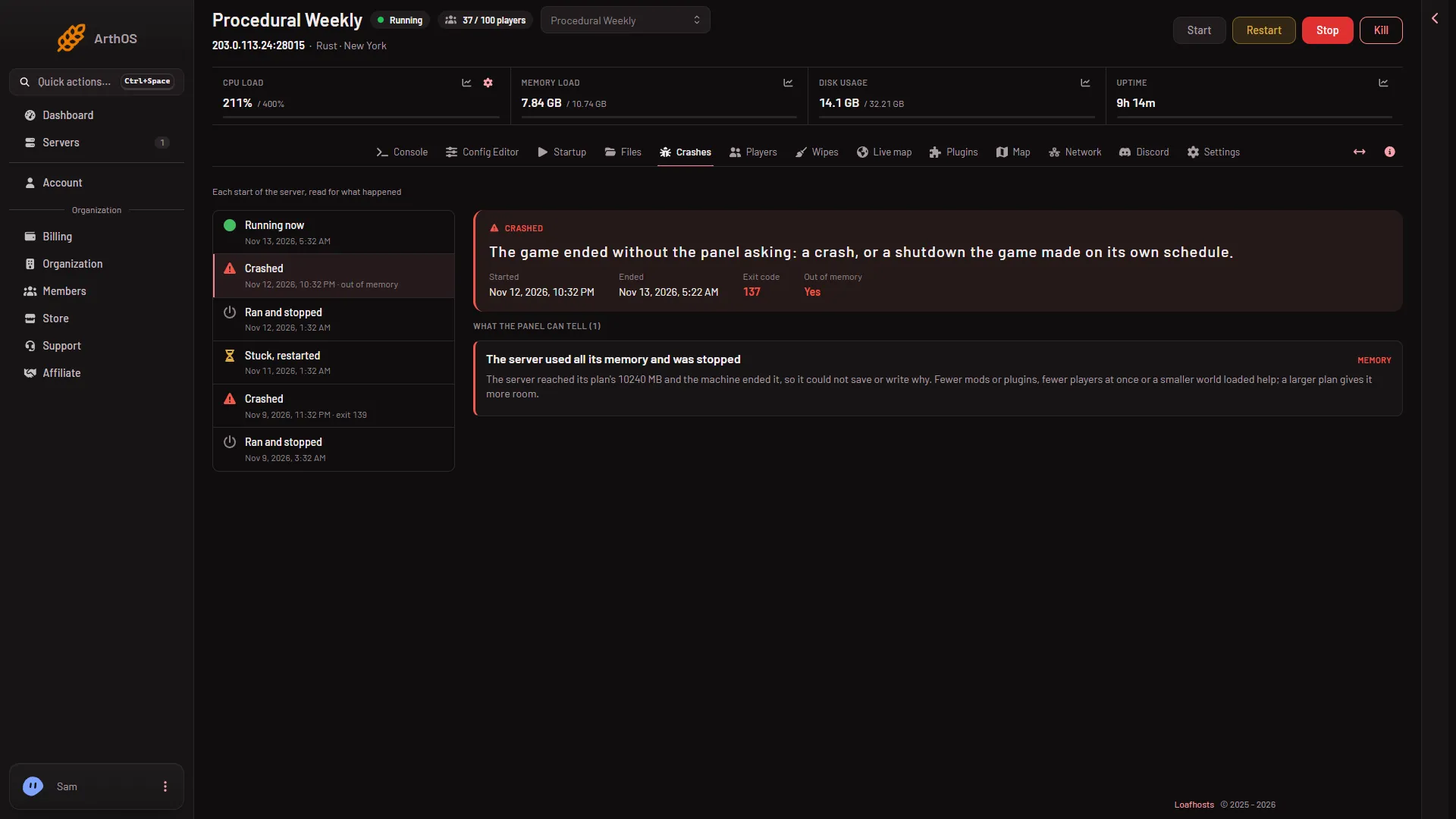
- Running now
- A crash
- Out of memory in the list
- Out of memory: Yes
- What the panel found
The words you can see:
| Outcome | What it means |
|---|---|
| Running now (1) | The server is up and players can join. |
| Starting | The server is still starting. |
| Ran and stopped | The server started, ran and stopped normally. |
| Crashed (2) | The game stopped without being asked to. |
| Stuck, restarted | The game stopped answering, so the panel restarted it. |
| Failed to start | The server never got as far as letting players in. |
| Ended early | The log ends without saying how the server stopped. Here the panel means its own records, not a log file. |
A stop you asked for, from the panel or a schedule, reads Ran and stopped. A server that stopped because nobody played is standby, not a crash.
Open a start
Choose a row. The top shows Started, Ended, Exit code and Out of memory (Yes or No). Under What the panel can tell, each finding has a title and what to do. For a crash it shows “The game ended without the panel asking: a crash, or a shutdown the game made on its own schedule.”
What the findings mean
- The server used all its memory and was stopped. The list says “out of memory” (3) and Out of memory reads Yes (5). The finding sits under What the panel can tell (4). The machine ended the server when it reached its plan’s memory, so the game had no time to save or write why. Fewer plugins, fewer players at once or a smaller world loaded help. A larger plan gives it more room. See Rust out of memory.
- Exit code 137. The server was killed: by the machine for memory, or because it would not stop in time.
- Exit code 139. The game crashed inside itself. A plugin or a damaged world is the usual cause. Remove the last plugin you added and start again (see Rust plugins).
- Any other exit code. The panel says the console’s last lines usually say why. The server was started again by itself.
- The server stopped answering. The panel saw it running but no longer answering, and restarted it.
A start with no finding says: “The panel’s records say no more than this. For the newest start, the console’s last lines are below.”
Read the console lines
For the newest start only, the page shows the last lines of the console. Read them from the bottom up for the last thing the server printed. Older starts have no lines, because the server’s container is made again at each start.
If the lines are not enough, open the Console while the server runs, or watch Memory Load at the top of the page. A small chart icon beside each reading opens Resource History, which keeps 30 days of memory, CPU and when the server was offline. For slow play without a stop, see Rust server lag.
If it does not work
- The list is empty. The page says “The panel has no starts of this server in the last 30 days.” The page reads the last 30 days and the newest 60 starts.
- No Crashes tab. Your role needs permission to read file contents.
- A crash and no cause. A memory kill and a hard stop leave nothing in the console. Check Out of memory and the Exit code first.
The page only reads. Nothing on it changes the server.
More about the game: Rust servers.